DISPATCH 001 // SIGNAL // NIGHTLIFE 6 MIN
The Room that Deleted Itself
One of the most sought-after rooms at Dark Mofo had no listing, no signage, no way in, only a name. That’s not an oversight - it’s a strategy
Three years ago Dark Mofo’s Red Room appeared in the program. It was hard to get into but it existed on paper, if you knew where to look. You could point at it. You could want it out loud. In 2026, it was not advertised at all.
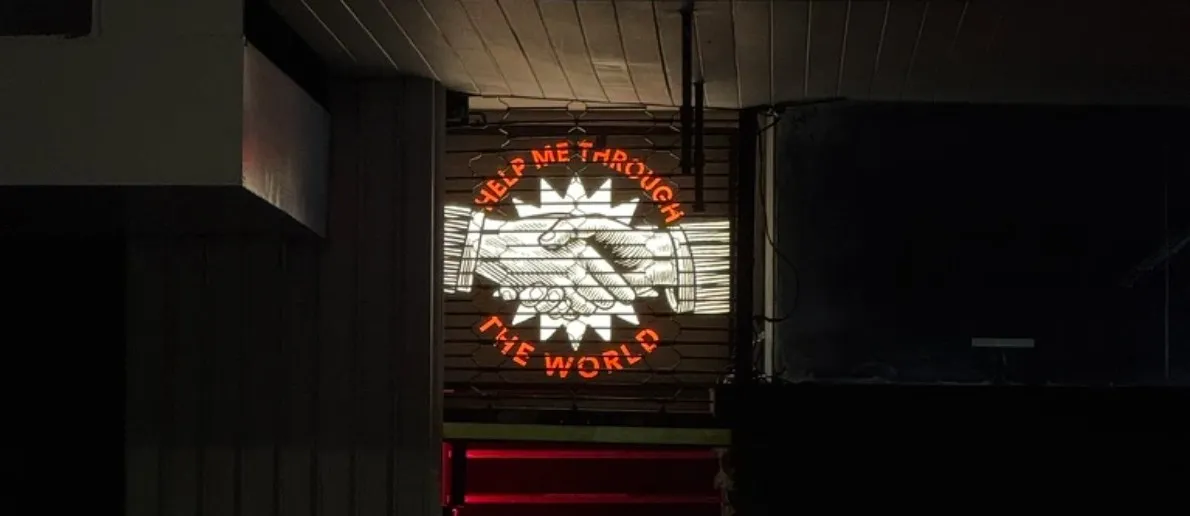
Wanting to relive and recreate our experience from Dark Mofo 2023, an exciting part of it was getting into the Red Room. We checked beforehand and it was missing from the program, instead replaced by a similar concept, an undisclosed location you have to treasure-hunt for, called Help Me Through the World. We found the location, and while standing in the queue waiting to get in, I decided to walk over to where the Red Room had been in 2023 and asked the security: “is the Red Room still here?” The answer was yes - but you would no longer find it written down anywhere. No listing, no link, no line on the map.
The Red Room now moves entirely by word of mouth, through artists and invited guests, a space that officially does not exist for anyone not already told. This is not a logistics decision. It is a signal and it is worth reading closely.
01 — THE DECOY ECONOMY
Here is the structure as we found it. The publicly ticketed late-night offering, Help Me Through the World : fifty dollars, a queue, performance art until the small hours, functions as the visible product. It was genuinely good. It is also, functionally, a decoy: a legible, purchasable version of the underground that satisfies the demand for transgression at scale, so that the actual inner room stays unlooked-for. The people queuing outside it are not being excluded from the real thing. They are being absorbed by its cover story.
“The program you can read is only the part of the iceberg designed to be photographed.”
02 — WHAT’S ACTUALLY NEW
Let’s be honest about what isn’t. Exclusive rooms are not a 2026 invention - they are as old as nightlife itself. Sydney has always had them. Level 6 at the Ivy has kept a floor most people will never see. When The Press arrived, half the brand was the rejection - a dress code and a door that turned people away and everyone knew it, because being turned away was the point. Every city with a night has a room above the room. Gatekeeping is permanent infrastructure. That part is not the story.
Most exclusive rooms are gatekept and advertised. The velvet rope performs — the whole value of those rooms is that you know it exists and know you can’t get in. That is visible scarcity: status measured by being seen excluded, or seen getting in. The exclusion markets itself, and the photo from inside is the trophy.
What we found at Dark Mofo is the opposite move. Rooms that are gatekept and erased: no listing, no signage, no photo permitted, no evidence you were ever there. This is invisible scarcity. The moment a space becomes fully visible, it fills with people who came because it was visible and whatever made it worth finding evaporates.
“Every good room eventually dies of being found.”
This does not only apply to just exclusive VIP rooms, but to smaller rave and music collectives as they start to scale up. When the entire world is searchable, findable, geotagged and reviewed, the old flex of the visible rope stops working - everyone can see the rope, and half of them can buy their way past it. So the flex inverts. The ultimate status is no longer being seen getting in. It is getting into a room that officially does not exist and having no way to prove it.
The algorithm didn’t invent exclusivity. It made exclusivity so easy to see and so easy to fake, that the real elite had to disappear entirely to stay ahead of it. Visible scarcity has been solidifying into invisible scarcity for a few years now, quietly.
03 — THE DOOR STILL RUNS ON HUMANS
What gets you in when you belong in the room but not on the list? Based on direct observation: presentation, confidence and conduct. If you have a partner-in-crime who amplifies your collective aura, the chances are higher. Know what kind of people frequent the room. Dress with intent. Walk like you have been before. The door is not checking credentials. It is making a judgment call, the oldest technology in nightlife. Venues like these is how they protect a space for its own: in this case, the artists, the locals who made this festival come to life, the people who will still be here in July.
04 — WHAT WE CAN TELL YOU
We got in. Watched the performance art front row. Met some interesting personalities - good & bad - and had some intriguing conversations. Wrapped the final night of the festival at 4am. That is all we will say.
Not because there is nothing to describe, because describing it is the price of admission, paid in reverse. These rooms run on a simple contract: what happens inside stays inside (is what the security in the long fur coat told us as he let us in). Break it in print and you have not reported on the underground; you have ended a small piece of it. It is meant to be kept as lore, shared amongst your friends. The trophy is the unpostable fact of having been there - spendable only in conversation.
“Some rooms you earn by not writing about them.”
The algorithm cannot make this edit. That is the point. Some rooms you earn by not writing about them and for a lot of them, the ones worth earning have stopped writing about themselves.
Culture is re-learning word-of-mouth tradition. Dark Mofo in June was field evidence of that Signal. A lot of societal signals are cyclical like a pendulum. Let’s see where this one swings.